Internal vs External vs DMA Cheats: Why DMA Is Winning the Undetected Race
Understand the key differences between internal, external, and DMA cheats, and discover why DMA hardware cheating is rapidly becoming the only way to stay completely undetected against modern kernel-level anti-cheat systems.
By Administrator
Understand the key differences between internal, external, and DMA cheats, and discover why DMA hardware cheating is rapidly becoming the only way to stay completely undetected against modern kernel-level anti-cheat systems.
Internal vs External vs DMA Cheats: Why DMA Is Winning the Undetected Race
The world of game cheats has evolved into three main categories: internal cheats, external cheats, and DMA (Direct Memory Access) cheats. Each approach has its own strengths, weaknesses, and detection profiles. If you’re serious about staying undetected against modern kernel-level anti-cheat systems like Easy Anti-Cheat, BattlEye, or Vanguard, understanding these differences isn’t optional—it’s essential.
Internal Cheats: Deep Integration, High Risk
Internal cheats work by injecting a dynamic link library (DLL) directly into the game’s process memory. Once loaded, the cheat becomes part of the game itself, hooking rendering functions, accessing internal game objects, and manipulating gameplay in real time.
This deep integration allows for rich features: detailed ESP, smooth aimbot, radar hacks, inventory manipulation, and nearly anything else the game can do natively. However, this power comes at a steep price. Because the cheat runs inside the game process, anti-cheat systems can scan for unauthorized code, modified memory pages, or suspicious hooks. Even advanced manual mapping techniques often leave traces that kernel-level anti-cheats are designed to find. Internal cheats require constant updating to stay ahead of signature scans, and a single detection can lead to an immediate account or hardware ban.
External Cheats: Safe Distance, Limited Capability
External cheats operate as separate processes that read and write to the game’s memory from the outside, typically using Windows API functions like ReadProcessMemory and WriteProcessMemory. They never touch the game’s process space directly, which makes them inherently harder to detect than simple injected cheats.
The trade-off is speed and capability. External cheats must constantly cross the boundary between processes, introducing latency and limiting how smoothly features like aimbot or ESP can run. Overlays are drawn separately, which can look clunky and sometimes trigger screen capture detection. More importantly, modern anti-cheat systems now monitor system-wide API calls and kernel callbacks, making external cheats far from invisible. While they may buy more time than internal cheats, they are still vulnerable to behavioral flags, pattern scans, and eventual signature detection.
DMA Cheats: The Hardware Advantage
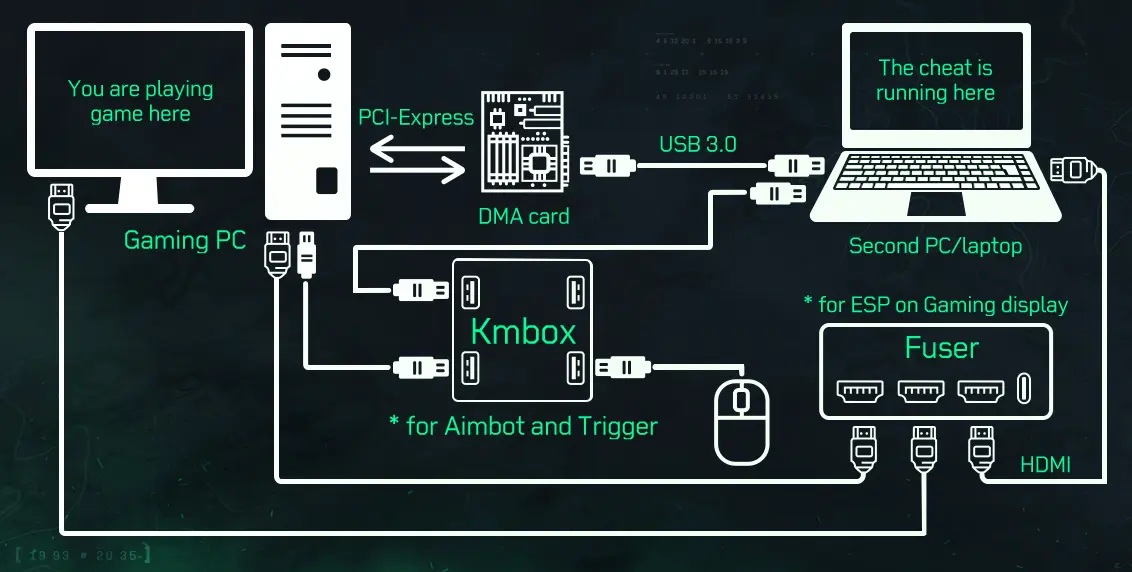
DMA cheats take a fundamentally different approach. Instead of running any cheat software on the gaming PC at all, they use a physical DMA device—typically a PCIe card or specialized hardware board—to directly access system memory. All memory reading and writing happens through the hardware, with zero code execution inside the game or even the operating system’s monitored space.
From the anti-cheat’s perspective, the gaming PC is completely clean. The cheat runs on a separate computer connected to the DMA device, reading memory at the hardware level. No suspicious processes, no injected DLLs, no hooked APIs. The result is a cheat that is functionally invisible to all current kernel-level anti-cheat solutions, including the latest versions of EAC, BattlEye, and Vanguard.
DMA setups do require a second PC and a compatible DMA card with custom firmware, but for those who value staying undetected above all else, the investment is the cost of playing permanently under the radar.
Side-by-Side Comparison
- Detection Risk: Internal cheats are the most exposed, external cheats provide some distance, and DMA cheats remain undetectable at the software level.
- Feature Richness: Internals offer the most features; externals are limited; DMA can achieve near-internal feature sets when paired with a well-built second-PC solution.
- Performance: DMA delivers memory reads with minimal latency, often outperforming even internal cheats for vision-assisted aimbots and full-map ESP.
- Maintenance: Internals and externals need constant updates to dodge detection; DMA firmware rarely needs changing once properly configured.
- Cost & Setup: Internal and external cheats are cheap or subscription-based; DMA requires hardware but pays for itself in avoided bans.
Why DMA Is the Superior Choice Today
Anti-cheat technology has shifted heavily toward kernel-level monitoring and behavioral AI like Anybrain. These systems are extremely effective at catching cheats that touch the game process or leave user-mode traces. DMA bypasses all of that by never interacting with the game through software at all. The anti-cheat simply has no entry point to detect.
Even behavioral analysis struggles to flag a DMA cheat when configured with humanized settings. Smooth aim curves, natural-looking recoil control, and realistic reaction delays make the data look exactly like a highly skilled player. Meanwhile, internal and external users face an endless cycle of bans, rebuys, and constant fear of the next detection wave. DMA breaks that cycle.
It’s not just about avoiding bans—it’s about peace of mind. With a properly set up DMA solution, you play without worrying whether today is the day your cheat gets signatured. You can enjoy the game on your main account, on your main hardware, knowing the anti-cheat is blind to your presence.
Don’t Forget the Spoofer
While DMA drastically reduces your chance of ever receiving a ban, no cheat is 100% immune to every possible variable. If you’ve already been flagged with an HWID ban in the past—or if you’re using DMA after getting banned on other setups—your hardware identifiers are still burned. DMA doesn’t magically scrub a pre-existing HWID mark. In that situation, you’ll need a trusted HWID spoofer to mask your real hardware before the anti-cheat ever reads it. Combined with DMA, this is the closest thing to a permanent, undetected setup currently available.
The Bottom Line
Internal cheats are feature-rich but extremely exposed. External cheats offer a slight safety improvement but can’t match the performance or stealth needed for today’s competitive titles. DMA hardware cheating is the only method that effectively removes software detection from the equation entirely. It’s not just a step up—it’s a completely different league. For players serious about long-term cheating without fear, DMA isn’t just the better option; it’s the only option that makes sense.